You can keep browsing what you already opened. Anything that needs the network will resume on its own as soon as it is back.
Back online
A new version is available
You can update now or carry on: the app never updates itself while you are using it.
Cookies
We use technical cookies, needed to sign in and remember your language. If you accept, we also use Google Analytics, to understand how Sherbeth is used, and the Meta and TikTok pixels, to measure our campaigns: how many people come from advertising and how many purchases follow. You can reject: everything works the same.
Read the full notice.
The chemistry of gelatowith Bruno PetronilliTalk
The chemistry of gelato
Research, technique and creativity in contemporary gelato
Saturday 14 November
·
20:00–20:45
Officina Culturale - Piazza Verdi
What makes a gelato creamy, stable and balanced? Chemistry helps us understand how ingredients behave, how they interact and how they build the structure of gelato. A meeting to discover what happens during production, and to turn scientific knowledge into informed choices in the workshop.
Who is there
With
Davide Cassi
Davide Cassi is Professor of Physics of Matter at the University of Parma, where he directs the Gastronomic Physics Laboratory. For over thirty years he has studied food as matter, applying physics to understand culinary transformations and to create new gastronomic processes and products. Between 1995 and 1998 he invented liquid-nitrogen gelato, now widespread worldwide. In 2002, with chef Ettore Bocchia, he originated Italian scientific haute cuisine, opening a path of collaboration between research and fine dining. In 2006, at Cantine Aperte at Carpenè Malvolti in Conegliano, he made for the first time a gelato obtained solely from bottled wine, without milk, eggs or base mix. Crystallisation, emulsions, foams, gels and phase transitions are his research fields; through Future Cooking Lab he transfers this knowledge to innovation in the food industry and restaurants. In recent years he has opened the front of computational gastronomy, applying network science to recipes, historical cookbooks and culinary systems. He is a founding member of the International Society of Scientific Gastronomy and vice-president of the Science and Cooking World Congress, and teaches every year at the Universitat de Barcelona. In 2013 the Académie Internationale de la Gastronomie awarded him the Grand Prix de la Science de l'Alimentation; in 2026 the International Bergamot Academy appointed him Ambassador. His most recent book is Pasta cruda, pasta cotta (Maretti, 2025).
With
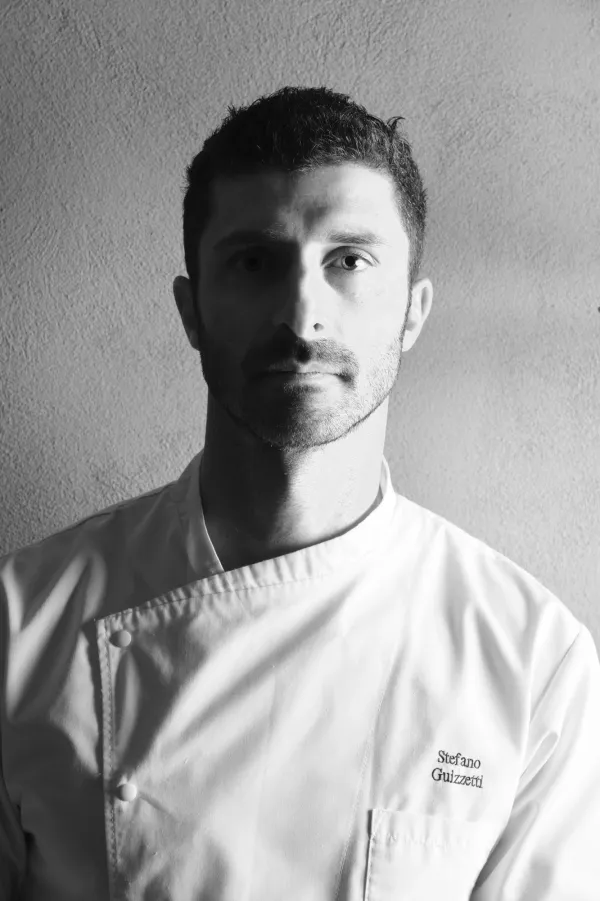
Stefano Guizzetti
Stefano Guizzetti founded the gelateria Ciacco in Parma in 2013. Its ingredient list excludes anything not already naturally present in the raw materials used every day in the shop. The knowledge gained during his degree in Food Science, together with research and experimentation, led to the first Italian artisanal gelato free of any food additive, natural or artificial — the subject of a university scientific publication. In 2014 the project grew with a shop in the centre of Milan, in via Spadari, the so-called 'Via del Gusto'; in 2024 the 'Laboratorio Urbano' opened in Milan as a new centre of production, experimentation and innovation for both gelato and pastry. A lecturer at ALMA, Accademia Barilla and many training centres, he works with leading chefs' associations, restaurateurs and food companies as a master pastry and gelato maker. Over the years his pairings have become ever more refined and original, with new lines from large leavened products to viennoiserie, from creams in jars to fermented products. A member of the Italian Association of Ambassadors of Taste, he has held Gambero Rosso's Three Cones since January 2017 and was named Italy's best gastronomic gelato in 2019; since 2023 Ciacco is also in Identità Golose's guide to Italy's best restaurants. In November 2024 he received the MAM award as Master of Art and Craft; in December 2024 and 2025 Ciacco was named Italy's best panettone by Dissapore (second for Gambero Rosso), and in June 2025 and June 2026 Italy's best gelateria by Dissapore.
With
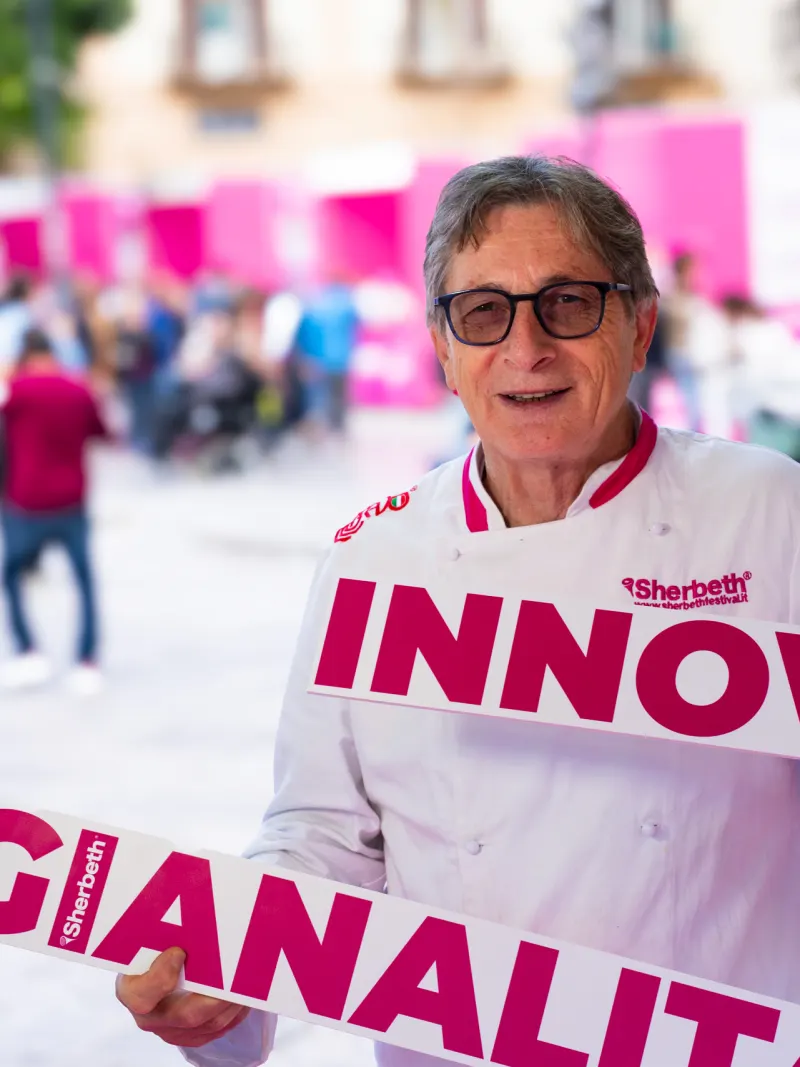
Arnaldo Conforto
Direttivo Tecnico
Arnaldo Conforto grew up in a family that has worked in the dairy sector for three generations, gaining experience in processing and preserving milk. At the end of the 1970s he also took up beekeeping.
In 1990 he opened a café-gelateria and furthered his training through the studies of Luca Caviezel. In 1997 he involved his son Flavio in developing Gerigel, software dedicated to formulating and managing recipes.
He joined the Accademia della Gelateria Italiana in 1998. In 2007 he took part in founding the association I Maestri della Gelateria Italiana and later in creating the Scuola Italiana di Gelateria in Perugia, where he taught for as long as it was active.
In 2010 he founded Artigiani del Gusto with his children. In 2012 he obtained the professional qualification of Specialised Master Gelato Maker and a qualification as a sensory analysis judge. Alongside his professional work he provides training and consultancy.
He coordinates the workshop of the granita festival A’ Nivarata together with Ruben Pili. At Sherbeth he began by working alongside Giorgio De Pellegrin, at the invitation of Antonio Cappadonia. He is a member of the Technical Board and head of the workshop.
Hosted by
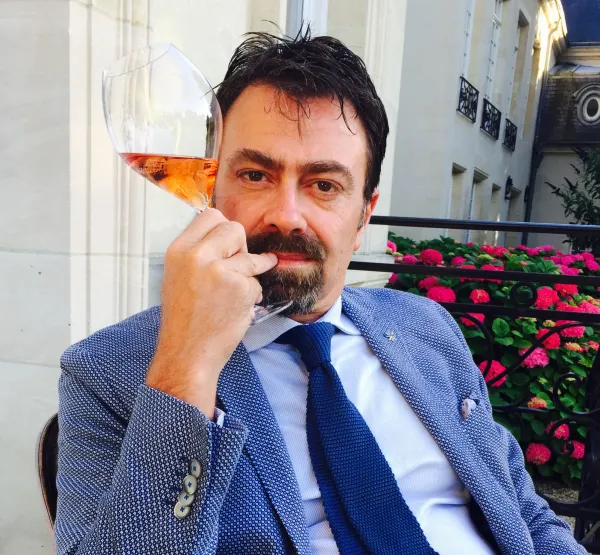
Bruno Petronilli
Born in 1966, journalist, graduate in political science, lifelong Inter supporter raised in Milan: he began his career in 1992 in Umbria, which is now his home. He started as a film critic, but the call of the palate soon prevailed and he chose food and wine. For many years he contributed to L'Espresso guides and has always worked with Identità Golose. In 2017 he founded and still edits James Magazine, a bold and innovative periodical born of an editorial vision rooted in the pursuit of absolute quality and a long familiarity with great Champagne, fine wines and signature restaurants. Sparkling wines have always been central to his work: a passion that became a language and a way of telling stories. Since 2025 he has also edited Sparkling Life, a bimonthly devoted to the effervescent world, and since May 2026 Portraits, the print magazine of Champagne Society, entirely dedicated to Champagne. He also directs the first World Guide to Roman pinsa.
1. You buy Tasty2. You show your QR3. Discover the Gelato itineraries4. Review and win5. Transfer TASTY, anywhere and to anyone6. You join our events7. You find where the makers are
Tasty are the festival's credit. Buy them as often as you like from your phone or at one of the tills — then wander among the stands and enjoy your gelato.
One Tasty is worth one euro of gelato. But each package is an offer of its own: the bigger it is, the more tastings we throw in. Keep an eye on the promotions.
There are many ways to cross Sherbeth: following your curiosity, letting an ingredient guide you, finding a familiar flavour again. Or taking a new road and seeing where it leads, one taste at a time.
That is how «Gelato itineraries» are born: 10 cross-cutting tasting routes, each with 6 stops, weaving together flavours, places and interpretations through affinities and contrasts, new perspectives.
Not sure where to start? The “What gelato are you?” quiz suggests yours. Pay with the QR at one of the itinerary’s gelaterias and the passport stamps itself, even for the tastings you had before signing up.
Complete an itinerary, any itinerary: you get a Conetto on us in your Wallet, ready to collect at the counter.
A few minutes after each tasting you can rate that gelato, until 16 November: one vote per gelateria. The votes cast by 15 November decide the People's Choice Award. With 25 votes you become a Grand Juror: the badge shows up in “My festival”.
Every 6 votes a Conetto on us, landing in your Wallet by itself: up to 10 in all.
You can send Tasty to anyone, as many as you like, and receive them from anyone who sends you some. And if you are holding a receipt with Tasty on it, you load it and they land in your wallet: that works even for a receipt you did not buy yourself.
Whatever is left stays where it is, and you can always hand some to whoever is with you.
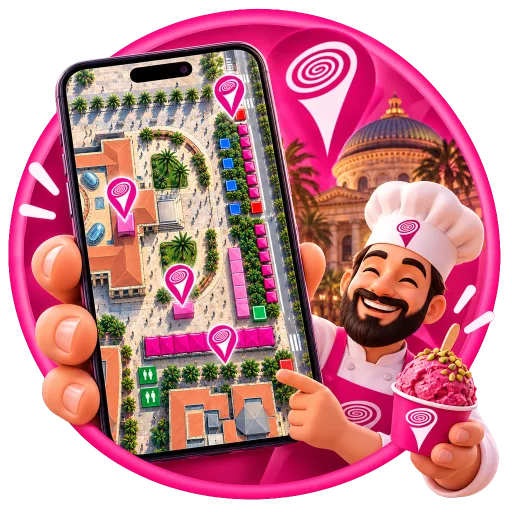
Who is taking part, which flavours they offer and where in the square their stand is: the map tells you in one tap, and each maker's page tells you the rest.
Favourite the ones you want to taste: you will find them together once you are there.

 Talk